
By Mark Davies, Programme Manager (Science & Health) at the Wolfson Foundation.
The Wolfson Foundation has a long record of supporting scientific research that addresses the climate crisis, supporting pioneers like the University of East Anglia’s Climatic Research Unit as long ago as the 1970s. Outside the scientific arena, our grant holders are increasingly using Wolfson’s capital funding to become more sustainable and encourage their communities to take action on the environment.
Sunshine in January
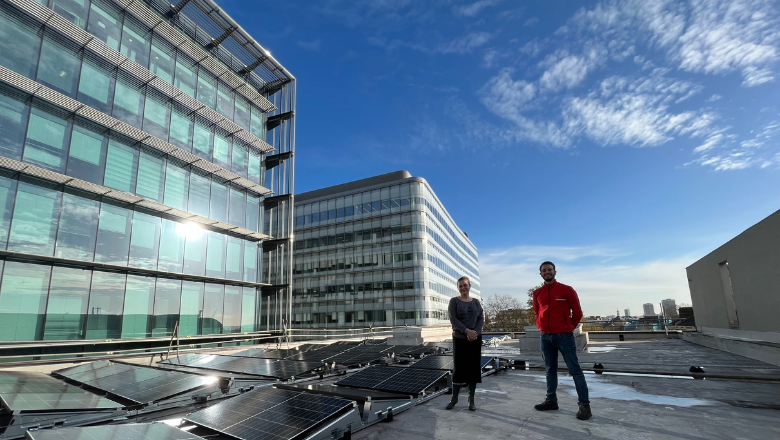
With immaculate timing, the sun shone brightly as the Unicorn Theatre, a stone’s throw away from Tower Bridge, unveiled its new rooftop solar panels (above).
The Unicorn, a specialist children’s arts venue, received a grant to install the panels under Wolfson’s joint programme with Theatres Trust to improve environmental sustainability in the sector.
To date, we have supported 19 theatres. Demand has been high, and Wolfson and the Trust are committed to running further rounds of the scheme in 2022 and 2023. It’s a sign of the growing importance of tackling the climate emergency, both for a funder like Wolfson and for the organisations we support, even in less ‘obvious’ sectors like the performing arts.
While those solar panels are brimming with the very latest technology, they build upon research carried out by a scientist whose work Wolfson supported over 40 years ago.
Meet ‘the dude’
Visit the rooftop of almost any residential building in Israel and the chances are you will be greeted by the sight of this rather no-frills contraption. The dude shemesh or ‘solar boiler’ became almost ubiquitous in the 1970s, harnessing solar energy to heat the water supply in houses and apartment blocks.
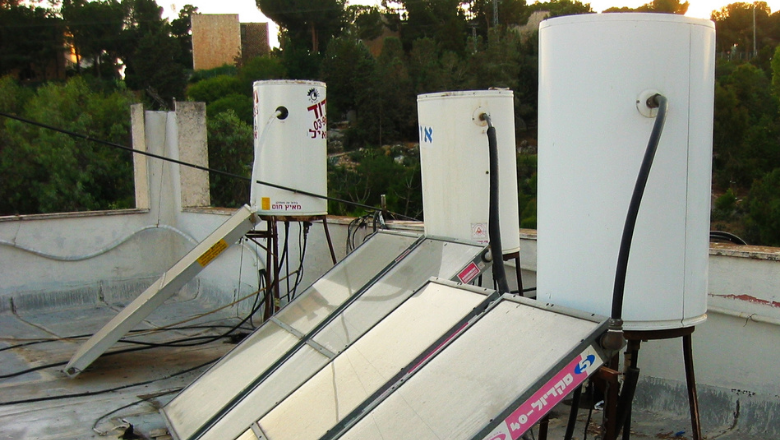
Gilabrand at English Wikipedia, CC BY-SA 3.0, via Wikimedia Commons
The technology behind these thermal panels was developed by Anglo-Israeli scientist Dr Harry Zvi Tabor in the 1950s. By the 1970s, as uncertainty over global oil supplies rose, there was a mini-boom in interest in solar boilers in the Mediterranean, Japan, Australia and elsewhere.
As Dr Tabor continued to look for ways to increase the efficiency of solar panels – he also had a sideline trying to develop a prototype hybrid electric car – he turned to the Wolfson Foundation for funding. We approved two grants in 1979 and 1981 to help him pursue his research.
Small steps, big ambition
Sadly the Wolfson archives shed little light on how this research fared. Presumably there were incremental gains and helpful new discoveries, feeding into subsequent generations of solar energy science and technology. Tabor was undoubtedly a great pioneer – one of his peers commented around the time of his 80th birthday that ‘of all the work in solar energy being done today, Tabor did it first.’ His electric vehicle did not come to market, but today’s scientific progress relies on yesterday’s failures as much as its successes.
This has been a defining theme of Wolfson’s funding down the years – a desire to seek out and support the best science, with the ability and ambition to achieve societal impact, and sometimes industrial adoption, long into the future.
Past and present
A few years before we funded Dr Tabor’s work, a grant was awarded to the University of East Anglia’s Climatic Research Unit – then in its infancy, and this year marking its fiftieth anniversary. Arguably their study of historic temperature records and modelling of future trends has done more than anything else to focus national and global attention – and action – on tackling climate change over the last three decades.
In the present day, as the world generates more energy from renewable sources such as solar and wind, one major challenge will be how to store and distribute that energy at scale. Researchers in Energy Storage Materials at Oxford University, based in experimental facilities part-funded by Wolfson in 2014, are pinning their hopes on a revolution in battery storage. This research is on a par with Oxford’s pioneering work in the 1970s on the now ubiquitous lithium-ion battery.
Our commitment
We are also taking our own action on the climate crisis. In our strategic framework for 2020 – 24, we acknowledged its increasing importance to us as a funder and the sectors we support. We have joined with over 80 grant-makers to sign the Funder Commitment on Climate Change, committing to keep learning, communicating, investing and deploying our resources in efforts to combat climate change.
Looking to the future
There is similar ambition among organisations across the various sectors that Wolfson supports. Our largest funding programme, supporting science research infrastructure, is seeing a steady rise in interest from some of the UK’s leading institutions in climate-related research. Recent grants include support for the British Antarctic Survey’s facilities to store and analyse polar ice cores, and a first-of-its-kind simulator at Loughborough University designed to future-proof transport infrastructure against extreme weather due to climate change.
Museums and heritage sites are also embracing the need to inform and motivate their audiences to act on climate change and environmental threats. We are delighted to be funding, for example, the Natural History Museum’s Urban Nature Project, and new climate change galleries alongside RRS Discovery in Dundee. With a pleasing circularity, this project will provide space for the British Antarctic Survey and other scientific organisations to communicate the research they do to a wider public.
We are committed to supporting our grant holders in all sectors to take action on climate change. Whether it’s making buildings more energy efficient or funding cutting-edge climate science, we are privileged to learn from their experiences.
Mark Davies is Programme Manager (Science & Health) at the Wolfson Foundation.
