

By Paul Ramsbottom
This year I have enjoyed being a judge for the World’s Best School Prize. It celebrates schools around the world that are transforming the lives of their students and making a significant difference to their communities. On a personal note, it has given me some small insight into the challenge – and joy – of judging prizes.
In my ‘day job’ at Wolfson, 2022 has also been a year of prizes. We have been celebrating 50 years of the Wolfson History Prize: a book prize recognising outstanding and accessible history writing.
And so, unsurprisingly, we have also been reflecting on the relationship between prizes and philanthropy. What is the point of prizes? The question perhaps becomes more pressing when considered in the light of significant societal need.
Recognition and celebration
The World’s Best School Prize shines a light on the achievements of exceptional schools around the world, often operating in very difficult environments with far too few resources. The prize is also a chance to celebrate teachers who all too often go unnoticed.
For the Wolfson History Prize, the prize is a moment in the literary calendar to focus on history specifically. There are several prizes recognising non-fiction, but the Wolfson Foundation determinedly focusses on brilliant history writing and its crucial importance to society. The Wolfson History Prize remains the highest value prize for history writing in the UK.
For the individuals recognised by the prize, there is great value in being recognised by other historians. Indeed, some of the country’s finest historians have served as judges over the years. We are delighted, in recent days, to have announced that Mary Beard and Sudhir Hazareesingh have joined the judging panel.
Generating discussion
Prizes inevitably generate discussion. They are a megaphone for key issues in our culture and help us to work out what matters.
One of the things we wanted to do to mark the anniversary of the Wolfson History Prize was to zoom out from this year’s shortlist – brilliant though it is – and use the prize as a platform to encourage discussion about history.
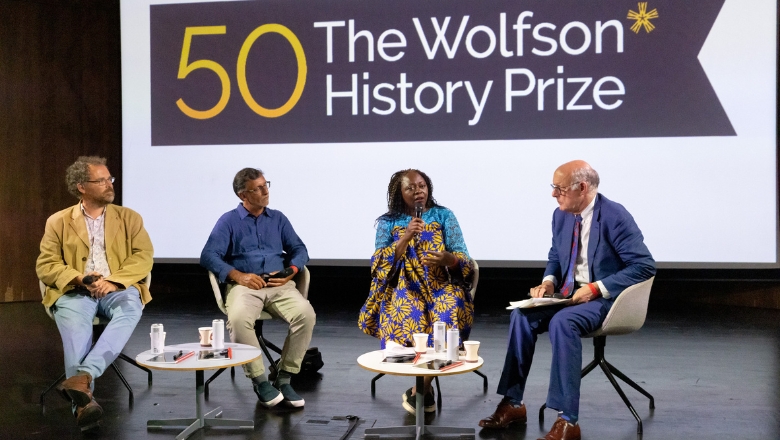
Toby Green, Sudhir Hazareesingh, Olivette Otele and David Cannadine recording a conversation at the V&A for the Wolfson History Prize’s anniversary podcast with BBC History Magazine.
So this year, we partnered with BBC History Magazine on a series of podcasts. We were joined by brilliant speakers – previous winners, shortlisted authors and other historians who are leading in their fields. Four episodes explore themes including the relationship between history and science, and how writing about our global colonial past has changed.
History is nothing if it does not encourage curiosity and debate, albeit hopefully informed by evidence and research. And informed historical debate – vexed and contentious though it may be – is crucial to a healthy society.
Values
Of course, while prizes generate debate, they also (whether explicitly or not) emphasise a set of values. The chair of judges, David Cannadine, wrote brilliantly about this earlier in the year, articulating the long and often complicated relationship between prizes and philanthropy as part of his account of the Wolfson History Prize’s 50th anniversary.
For the Wolfson Foundation, the values that lie behind the prize are easily stated. We think history and heritage matter.
Although we are probably best known as a science funder, a commitment to history colours much of our funding across higher education and cultural heritage. And we think history writing matters as much – if not more – than ever in these difficult days. It is important, as well as enjoyable, for healthy societies to promote and cherish informed historical debate, especially about subjects or voices which have been overlooked or which are being re-evaluated.
In a wider sense, there is surely a role for philanthropy to fund the aspirational – those things which lift our sights and draw attention to the beautiful and the interesting. It was the motivation that led to the funding of many of the great municipal parks in the Victorian era, for example. These days, organisations outside government have taken the lead in supporting these sorts of aspirational projects. This only underlines the ongoing and evolving relationship between prizes and philanthropy.
Prizes matter
Prizes matter. They create a space for celebration, for reflection and for discussion.
In running the Wolfson History Prize, we of course recognise superb authors. But it is a by-product of a wider ambition: to encourage more people to read history that is well written and brilliantly researched. Without that, informed public debate is impossible.
Paul Ramsbottom is chief executive of the Wolfson Foundation.
